Beheer NL_Wetenschap op Twitter

In de week van 16 t/m 22 november had ik de eer het Twitteraccount NL_Wetenschap te beheren. Dit account is een initiatief van de VSNU (Vereniging van Universiteiten) en heeft als doel een breed publiek te engageren bij alle takken van wetenschap. Het was een genoegen om een week lang mijn onderzoek te kunnen delen met anderen, die hun interesse toonden middels goede vragen en aanbevelingen. De enthousiaste reacties waren erg motiverend!

Jan III Sobieski and Romeyn de Hooghe (NL Embassy in PL)

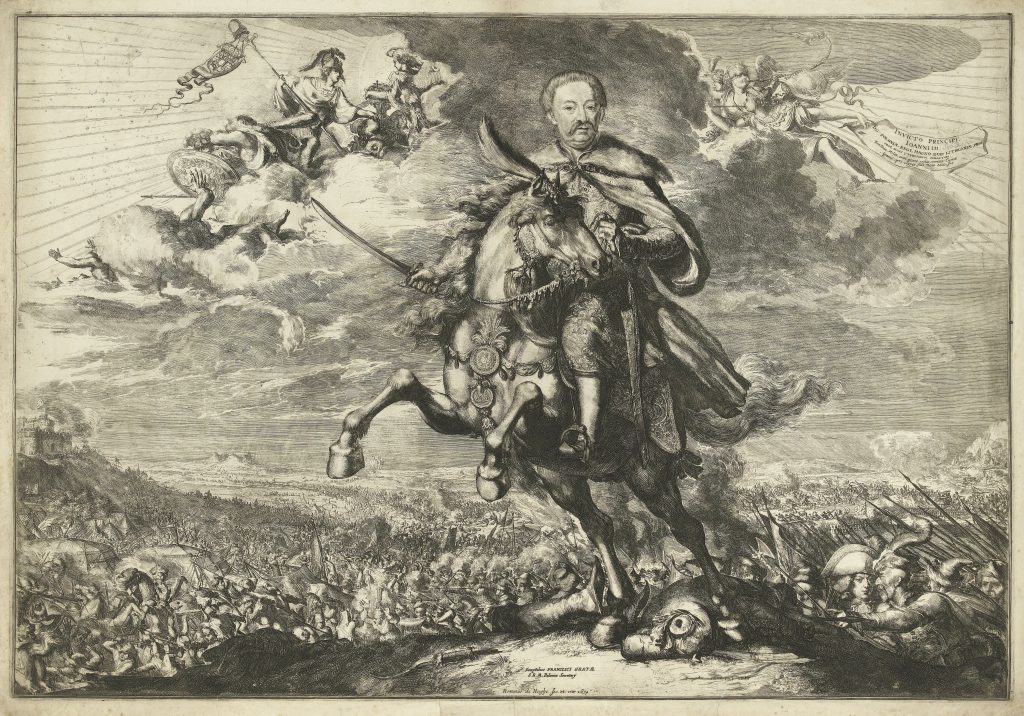
The most influential portrait of King Jan III Sobieski was made in 1674 by the Dutch artist Romeyn de Hooghe. It shows Sobieski at Chocim/Khotyn (in modern-day Ukraine), where he defeated the Ottoman armies on 11 November 1673. It was copied by various artists and helped spread Sobieski’s fame all over Europe. De Hooghe was granted the title Servitor Regis (servant of the king) and went on to produce several other engravings showing the Polish monarch. Following Sobieski’s victory at the Battle of Vienna in 1683, he was glorified by numerous Dutch artists and authors. More information about Sobieski and De Hooghe can be found in this recent Dutch article (which includes a summary in English).

Romeyn de Hooghe, Jan Sobieski at the Battle of Khotyn, 1674.

*I originally wrote this post for the social media outlets of the Dutch Embassy in Poland. This was post no. 3.

Bezem & Kruis: Vertaling Poolse cultuurstudie over Nederland gepubliceerd

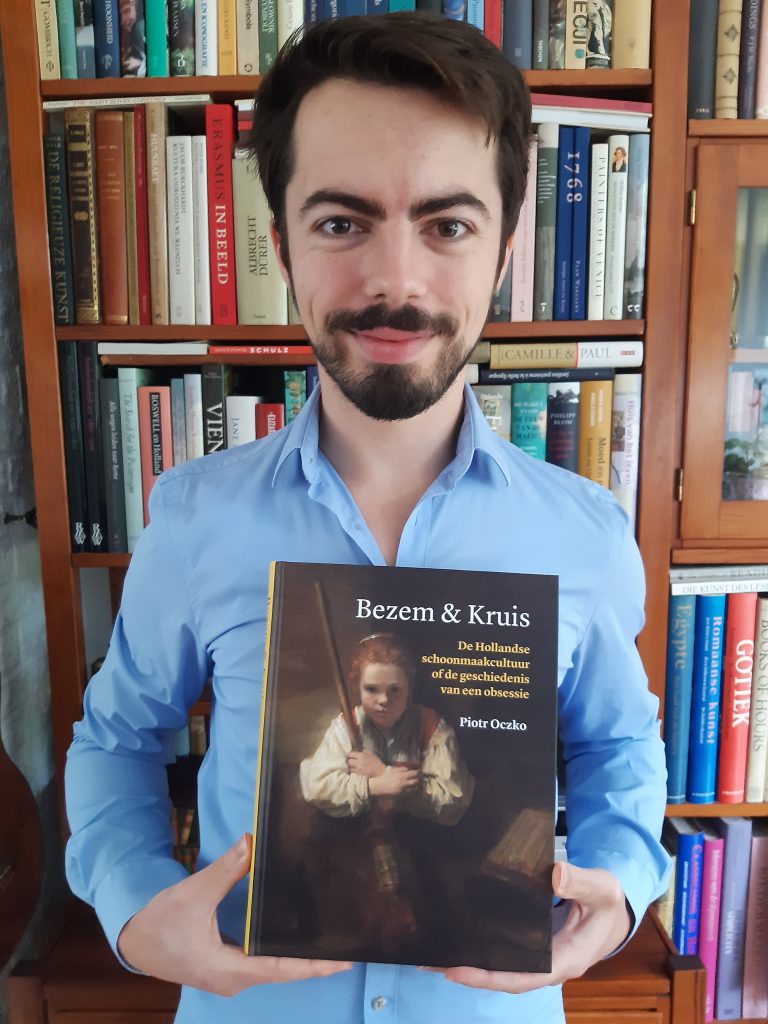
Deze maand verscheen bij de Primavera Pers in Leiden het boek Bezem & Kruis: De Hollandse schoonmaakcultuur of de geschiedenis van een obsessie, mijn vertaling van Miotła i krzyż: Kultura sprzątania w dawnej Holandii, albo historia pewnej obsesji. Het boek is geschreven door de Poolse letterkundige en kunsthistoricus Piotr Oczko, die is verbonden aan de Uniwersytet Jagielloński in Krakau.
Het rijk geïllustreerde werk vormt een studie van de Hollandse schoonmaak- cultuur door de eeuwen heen. Aan de hand van talrijke voorbeelden laat Oczko zien hoe het schoonmaken vanaf de zeventiende eeuw een belangrijke rol ging spelen in de kunst en literatuur van de Noordelijke Nederlanden, met name Holland. In binnen- en buitenland begon men schoonmaken en properheid te associëren met de Nederlandse cultuur en identiteit. Deze ‘obsessie’ met schoonmaken duurde voort tot in de twintigste eeuw.

Het boek is hier te bestellen.


Stanisław Maczek and Breda (NL Embassy in PL)

Some of the best-loved Poles in the Netherlands are without doubt General Stanisław Maczek and his 1st Armoured Division. In October 1944, they liberated large parts of Noord-Brabant. Maczek and his men are mainly remembered for the liberation of Breda on 29 October, during which no serious damage was done to the city. The inhabitants welcomed their Polish liberators with open arms, and Maczek was awarded the honorary citizenship of Breda. Following the war, many of Maczek’s soldiers remained in Breda and other parts of the Netherlands, where their descendants live to this day. This year, on 3 June, the Maczek Memorial Breda was opened to the public. An online Dutch exhibition on Maczek and the 1st Armoured Division – the texts for which I translated – can be visited here.

*I originally wrote this post for the social media outlets of the Dutch Embassy in Poland. This was post no. 2.

Familiar Foreigners: Paper at the Huizinga PhD Conference

On 13 October, I presented a paper at the yearly Huizinga conference for PhD candidates. Due to the pandemic, the conference was held entirely online. My paper was entitled Familiar Foreigners. Poles through Dutch Eyes in the Seventeenth Century.

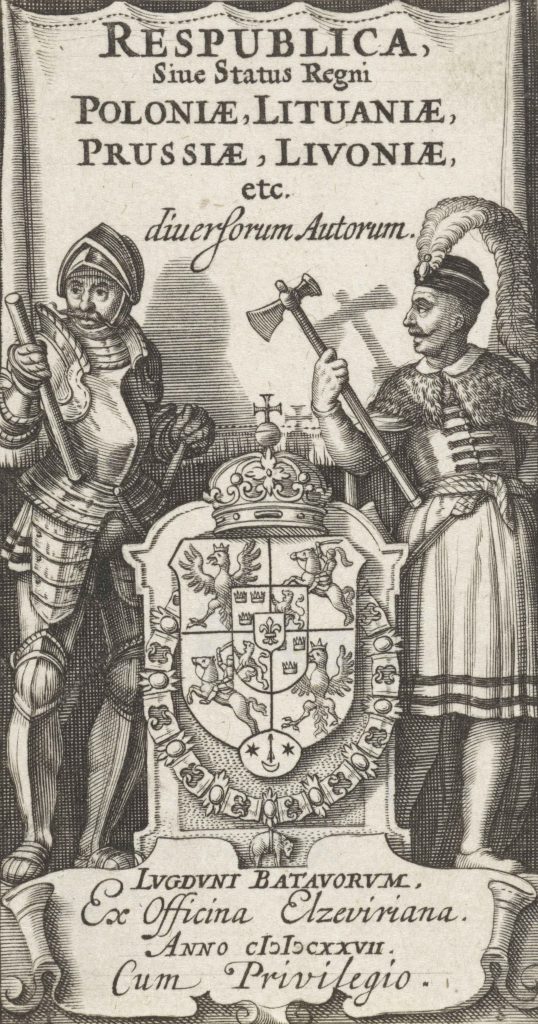
Pieter Serwouters, Frontispiece for ‘Respublica, Sive Status Regni Poloniae…’, 1627.

I discussed work in progress on the different ways in which the Dutch during the seventeenth century imagined the Polish people. Firstly, I analysed a variety of Dutch visualisations of ‘Poles’ and ‘Polishness’, ranging from engravings to gable stones and from paintings to ‘Polish’ stage costumes. While such representations were partly based on reality, a comparison with Dutch portraits of real Poles shows how these could break the mould. For whereas a Pole’s appearance was typically associated with the exoticism of the orient, and hardly differed from his Hungarian, Russian, or even Turkish counterparts, depictions of individuals could deviate from this pattern, as Poles navigated between ‘Eastern’ and ‘Western’ guises.

Secondly, I used several poems, travel accounts, and other sources to reconstruct the ways in which Dutch authors imagined Polish characters and customs. Typical Poles were identified as Sarmatians, a bellicose, brutal, and barbaric people, whose backward nature was shaped by the cold climate and severe living conditions of their homeland. However, these negative notions are challenged by several other sources, mainly Latin poems by Dutch authors in honour of their Polish friends. These compositions reveal that, despite the stereotypes, Dutch poets maintained and celebrated warm relations with Polish individuals in a variety of contexts, from scholarship to warfare to religion. Together, the visual and textual source material demonstrates that, through seventeenth-century Dutch eyes, Poles were familiar foreigners.

The oldest Polish town with Dutch roots (NL Embassy in PL)

Starting today, I will write regular posts about Dutch-Polish historic relations for the Dutch Embassy in Poland. The posts will appear on Facebook, Instagram and Twitter, but I will copy them here as well.

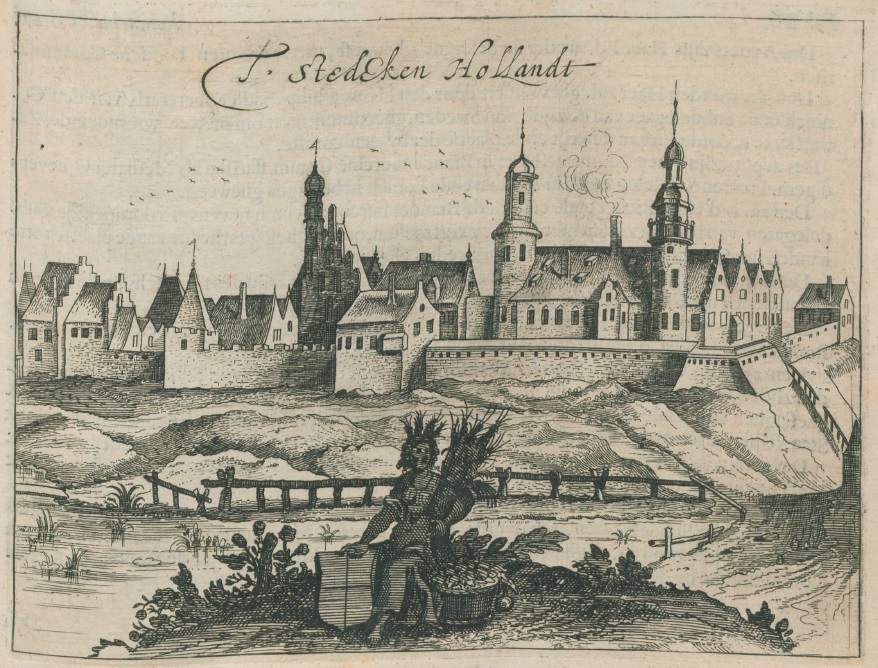
We begin with the oldest known town in Poland with Dutch roots. It was founded in 1297 in Prussian lands governed by the Teutonic Knights, and named after the settlers’ homeland: Holland/t (later known as ‘Preussisch Holland’). Some have argued that the founders may have been exiles and refugees, who had escaped their homeland following the murder of Count Floris V, in 1296. It is possible that Joost van den Vondel in 1637 referred to the founding of the town in his famous Gysbreght van Aemstel, when the play’s hero is advised to escape from Amsterdam to Prussia, and to build a ‘New Holland’ there. The settlement came under Polish rule in 1466 and was later part of the Duchy of Prussia, which remained a fief of Poland until 1657. A view of the town was included in a book printed in Amsterdam in 1632. In 1945, ‘Holland’ became part of Poland once more. Its modern name is Pasłęk, near Elbląg.

*I originally wrote this post for the social media outlets of the Dutch Embassy in Poland. This was post no. 1.

The Polish Hercules: Romeyn de Hooghe and Jan III Sobieski

I am happy to announce a new peer-reviewed paper, entitled ‘De Poolse Hercules. Romeyn de Hooghe en de Nederlandse receptie van Jan III Sobieski voorafgaand aan het Ontzet van Wenen’ (The Polish Hercules. Romeyn de Hooghe and the Dutch reception of Jan III Sobieski before the Battle of Vienna), published in Neerlandica Wratislaviensia.

Romeyn de Hooghe, Jan Sobieski at the Battle of Khotyn, 1674.

The paper explores the Dutch perceptions of the Polish king Jan III Sobieski before his famous victory over the Turks at the 1683 Battle of Vienna. Sobieski’s military triumphs and rise to power in the 1670s elicited various favourable responses from the Dutch Republic, most notably several prints by the etcher and engraver Romeyn de Hooghe. His prints laid the foundation for Sobieski’s image as a great European and Christian military leader, but also a specifically Polish and Catholic hero. Sobieski’s war efforts and the image formed of him by De Hooghe cohered with the negative Dutch perceptions of the Turks, as well as with Poland-Lithuania’s reputation as a bulwark of Christendom. The countless glorifying prints, poems and other European responses to Sobieski after his victory at Vienna were in many cases inspired by the image of the Polish monarch created in the Northern Netherlands during the 1670s.

The paper is in Dutch. An English version will be included in my dissertation.

Diplomats as Poets, Poets as Diplomats

I am very excited to have published a new peer-reviewed article, in Legatio: The Journal for Renaissance and Early Modern Diplomatic Studies, entitled ‘Diplomats as Poets, Poets as Diplomats: Poetic Gifts and Literary Reflections on the Dutch Mediations between Poland-Lithuania and Sweden in the First Half of the Seventeenth Century’.

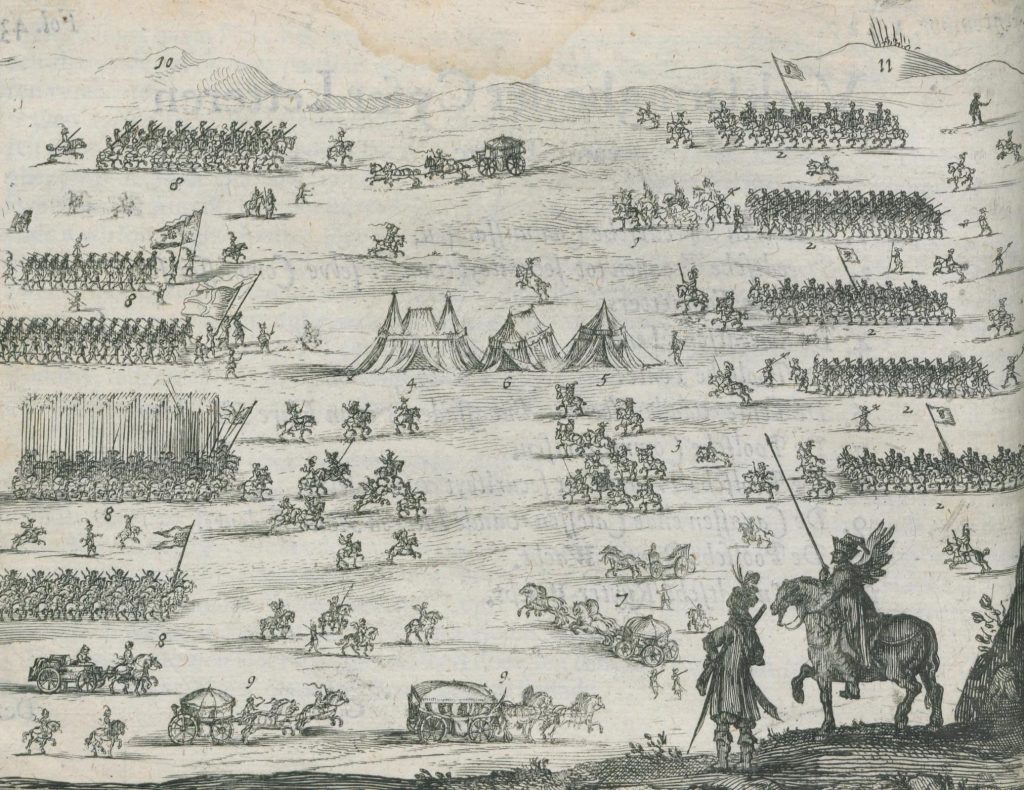
Abraham Booth, [Negotiations between the Dutch, Poles and Swedes in 1627], 1632

The article examines two Dutch diplomatic missions, in 1627-28 and 1635, by which the United Provinces intervened in a Polish-Swedish armed conflict in Prussia. The focus is on ‘diplomatic poetics’: the ways in which literature functioned within diplomatic practice, and how that practice (or the ‘diplomatic moment’) was in turn envisioned in literature. The Polish-Swedish conflict was of great interest to the United Provinces, and was elaborately discussed in various Dutch media, as well as in the correspondences of merchants and politicians. The Dutch embassies to Polish territories themselves, meanwhile, inspired a number of literary works, published mostly in the Republic, but also in for example Danzig and Königsberg. These sources demonstrate how early modern literary and diplomatic practices in Europe overlapped and influenced each other. Firstly, German, French and Dutch poems by Johannes Plavius, Simon van Beaumont and Joost van den Vondel illustrate the blurring of the lines between the realms of diplomacy and literature. Poems could function as diplomatic gifts, enabling both personal, intellectual communication and the widespread transmission of political messages. Moreover, Latin and German plays by Johannes Narssius and Simon Dach, and more importantly Latin poems by Simon van Beaumont and Caspar Barlaeus, as well as an illustrated Dutch account of the first mission by Abraham Booth, reveal that the Dutch envoys featured in literary narratives as both wise peace bringers and travelling poets, and their missions to Poland as both arduous ordeals and epic adventures. Much like poetic gifts, these literary reflections on ‘the diplomatic moment’ had public diplomatic agency, simultaneously voicing political opinions and crafting artistic images of the diplomats themselves.

At the Warsaw Institute of History

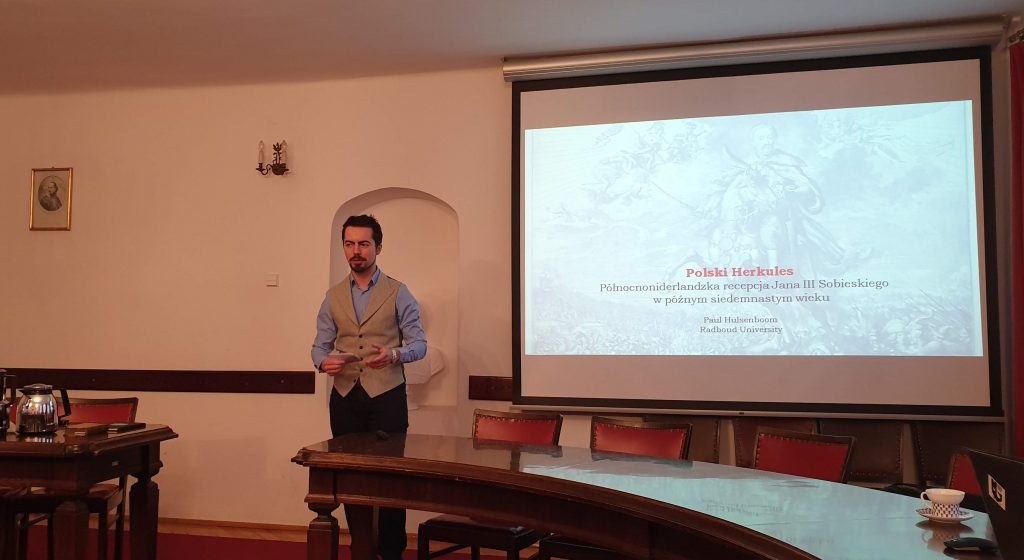
From 2 to 15 December, I am a guest researcher at The Tadeusz Manteuffel Institute of History of the Polish Academy of Sciences in Warsaw, which is located at the city’s Old Town Market Square. Besides doing research in Warsaw’s archives and libraries, I gave a presentation for members of the institute, entitled Polski Herkules: Północno-niderlandzka recepcja Jana III Sobieskiego w późnym siedemnastym wieku (The Polish Hercules: The reception of John III Sobieski in the Northern Netherlands during the late seventeenth century). I discussed the international importance of a series of prints made for the Polish king by the Dutch engraver Romeyn de Hooghe after Sobieski’s election in 1674, as well as the main characteristics of the wide range of poems and prints produced in the Northern Netherlands following his victory at the Battle of Vienna in 1683. The comments and questions I received were extremely helpful! My research stay is funded by an Erasmus+ scholarship.
Peripheral Polish Prussia?

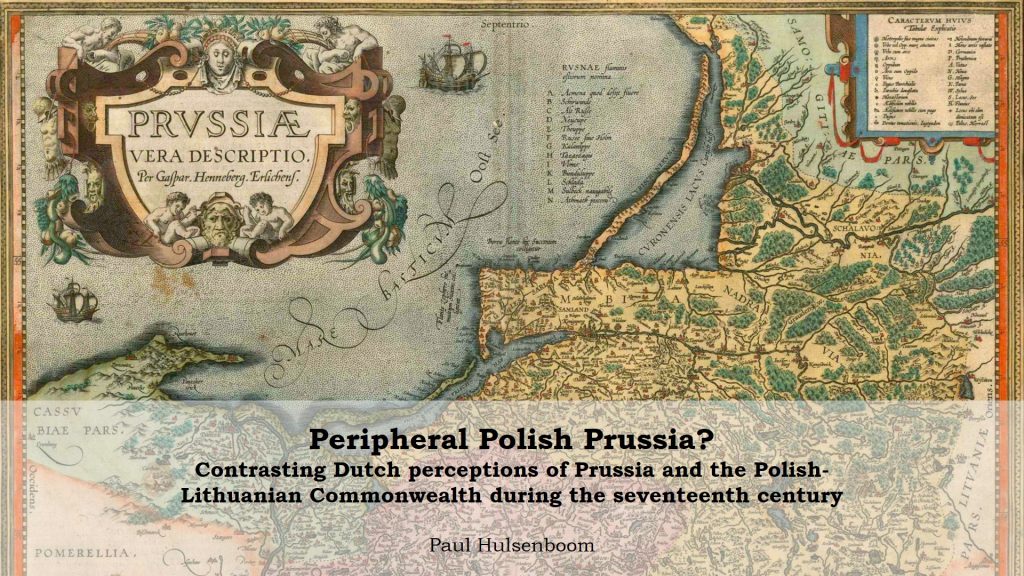
On 15 November, I gave a paper presentation at Radboud University’s international conference Is Europe Inclusive? Together with prof. dr. Marguérite Corporaal, I organised a panel on conceptions of European centres and peripheries throughout the ages. In my paper, entitled Peripheral Polish Prussia? Contrasting Dutch Perceptions of Prussia and the Polish Lithuanian Commonwealth during the seventeenth century, I argued that notions of centres and peripheries are ever changing and dependent on the observer. I used the case of Prussia, which during the nineteenth century was framed as the centre of Germanness, but which nowadays no longer exists as a geographic entity.

In my presentation, I posed the question how Prussia was perceived before its rise to power as an independent state, when during the seventeenth century it was under Polish rule. Royal Prussia, with Danzig as its most important port, was an integral part of the Polish-Lithuanian Commonwealth from 1569 to 1772, while Ducal Prussia was a vassal of the Polish king from 1525 until 1660. The observers I chose, the Dutch, had strong economic and cultural ties with Prussia. Did the Dutch view Prussia, which was culturally similar to the Low Countries and of great economic importance to the Dutch Republic, as a centre, or rather as a periphery and a mere province within the Polish-Lithuanian Commonwealth?

Using a variety of sources, I made clear that the Dutch had differing opinions about the region: while some sources preferred Prussia to Poland proper, saying that Prussian houses and grain were superior to Poland’s, other sources paint a different picture. Abraham Booth, who wrote the first Dutch eyewitness account of Poland-Lithuania, printed in Amsterdam in 1632, wrote an unflattering report of his journey through both Prussia and Poland. Negative elements were, for example, vast forests, cruel Polish soldiers, bad roads and shabby accommodations. This presentation is hardly surprising, as Booth wrote his account during a diplomatic mission to Prussia, in which the Dutch mediated between the Swedes and Poles after the Swedes had invaded Polish territory. The Dutch were officially allied with the Swedes, however. On the other hand, Poland and Prussia always feature favourably in the works of Joost van den Vondel, the most prominent Dutch poet of the seventeenth century. Vondel saw Prussia as belonging to Poland, and repeatedly praised the Commonwealth for its fertility and the role it played as a bulwark of Christendom. This no doubt had to do with Vondel’s Catholic sympathies. In this way, I hope to have shown that what constitutes a centre or a periphery is not fixed and easily measurable, but rather depends on the historical context and background of the observer.