160 years ago, the January Uprising broke out: an insurrection against Russian rule that took place in multiple parts of the former Polish-Lithuanian Commonwealth, which had been dismembered in the late eighteenth century. The uprising started in the night of 22 January 1863, in the Russian-controlled Kingdom of Poland, where several layers of society harboured a desire to regain independence from Russia. The revolt was ultimately triggered by the sudden forced conscription of Polish activists into the Russian Imperial Army – a measure which was actually meant to suppress the rising tide of patriotism.
The uprising was followed closely by foreign politicians and media, including in the Netherlands. During the November Uprising of 1830-31, Dutch sympathies had been generally anti-Polish and pro-Russian: inspired by the nearly simultaneous Belgian Revolution, Dutch commentators routinely labelled the Polish insurrectionists ungrateful and unruly. I wrote about these reactions in November 2021.
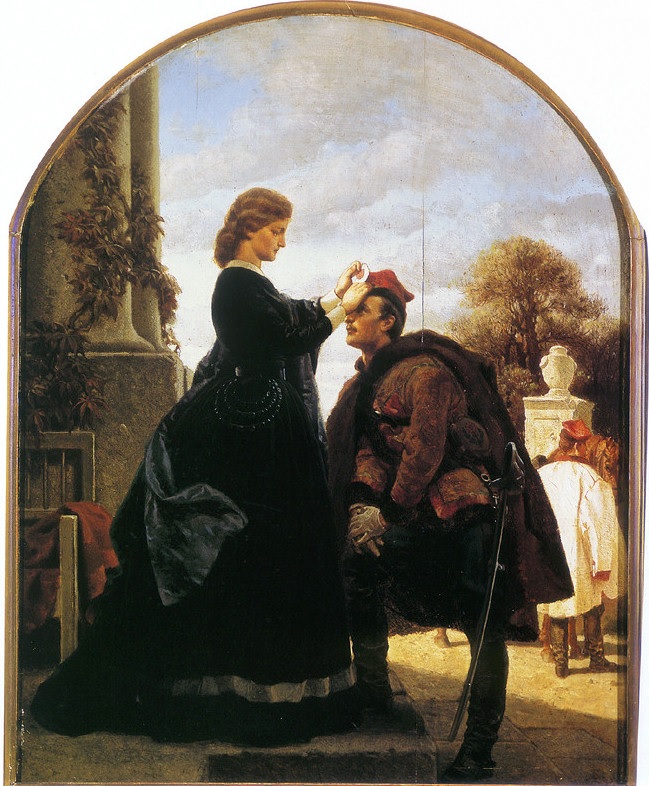
In the 1860s, things were different. The Belgian historian Idesbald Goddeeris has shown that Dutch responses to the January Uprising were far more diverse.* It took several months before any action was taken by the Dutch government, however: in May, the Dutch ambassador in Saint Petersburg presented a note of protest at the court of the tsar, in accordance with for example France and Britain. The event sparked a debate in the Dutch Lower House of Parliament, as the orthodox Protestant opposition attacked the liberal government for their action. In response, several MP’s defended the decision to support Poland (in spirit) by praising the Polish struggle for freedom. Some even compared it to the Dutch Revolt against Spain in the sixteenth and seventeenth centuries. However, others suggested that the Poles were aiming for the impossible, and were making themselves unpopular by using violence. King Willem III even explicitly supported the Russian tsar. Meanwhile, several Dutch publications once again framed the Poles as an unruly, anarchic, and even uncivilised and immature people, who actually profited from foreign occupation. In effect, the Dutch mix of Polonophilia and Polonophobia in the 1860s was principally guided by different political interests. No actual help was sent to Poland, however.
The January Uprising was the longest-lasting revolt in partitioned Poland. It was mainly fought as a guerilla war, encompassing many hundreds of battles and skirmishes. It ended in 1864, with the defeat of the insurrectionists. Tens of thousands of Poles, Lithuanians, Belarussians and Ukrainians were killed or sent off to Siberia. Following the defeat of the uprising, the russification of the rebellious lands was intensified. In 1867, what little autonomy the Kingdom of Poland had had was abolished completely.
The diplomatic efforts of Western powers to stop Russia had been fruitless.
*See: Idesbald Goddeeris, ‘Poland and the Netherlands in the 19th century’, in: Hellema, R. Żelichowski, B. van der Zwan (eds.), Poland and the Netherlands. A Case Study of European Relations (Dordrecht: Republic of Letters Publishing 2011), 41-54.
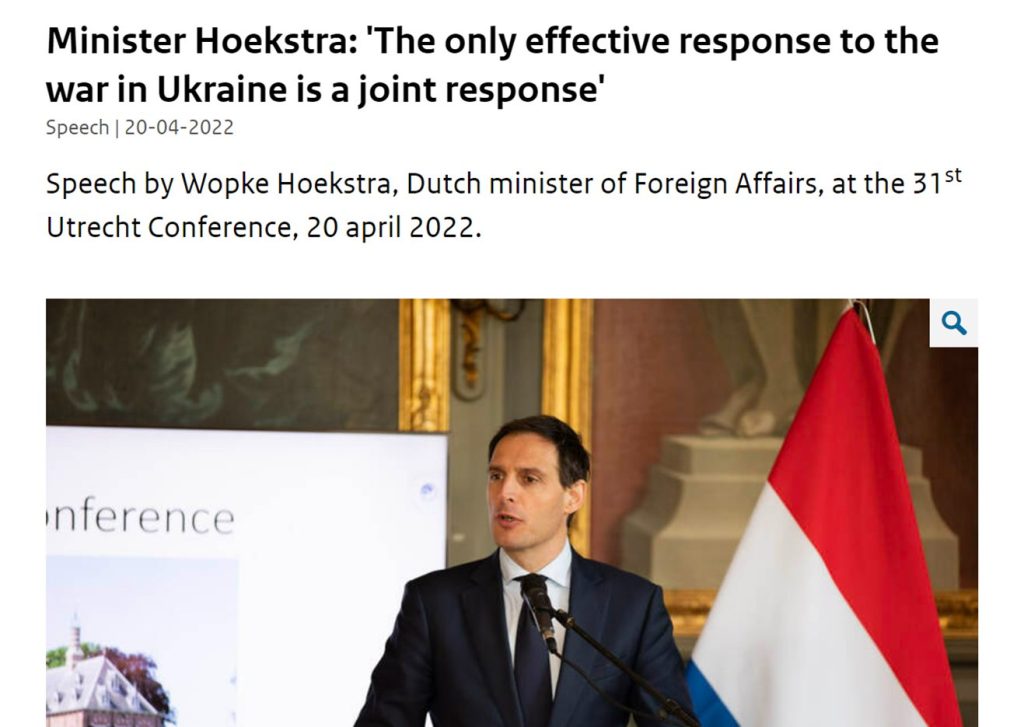
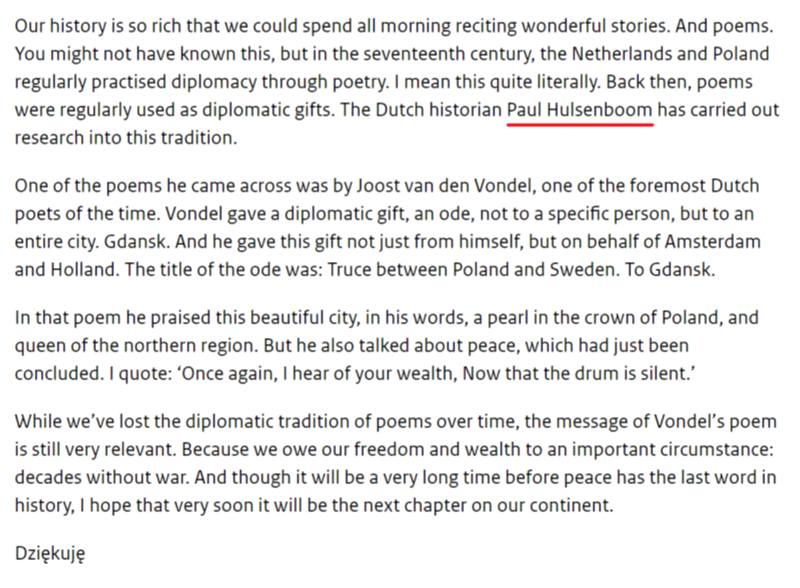 Hoekstra placed himself in that same 17th-century tradition by quoting the famed Dutch poet Joost van den Vondel, who praised Gdańsk in 1635 to boost the grain trade. Almost 400 years later, Vondel’s poem thus once again served to bolster Dutch-Polish relations. Also, Vondel’s definition of Gdańsk as “queen of the northern region” is a translation of a Latin verse about Gdańsk by the Polish poet Sarbiewski/Sarbievius, published in 1634. In other words: Hoekstra quoted Vondel quoting Sarbiewski. This is some serious intertextuality! Moreover, my own paper on early modern diplomacy has become part of the modern diplomatic process. And so have I: the fact that I’m a “Dutch historian” is especially relevant in this context (Hoekstra missed the opportunity to say that I’m also Polish, however).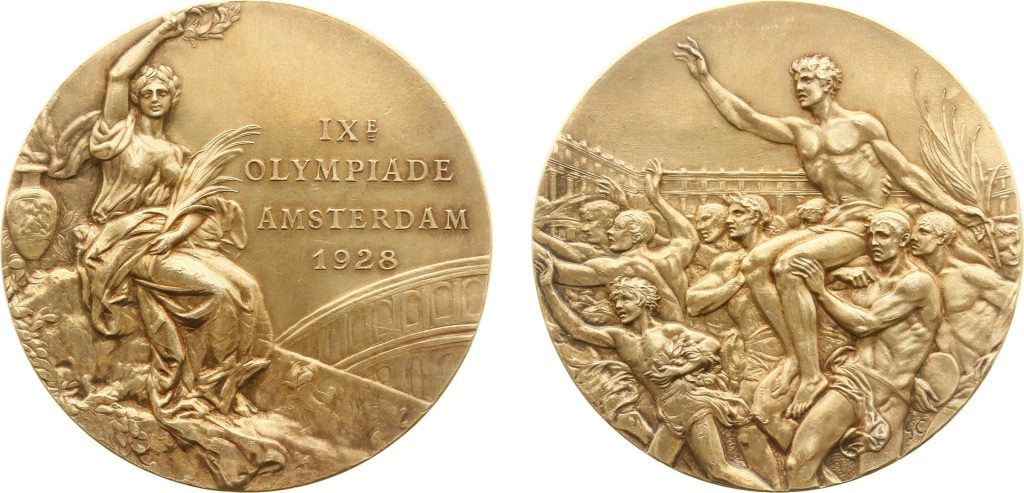

 Poland and the Netherlands share a rich history in sports. Right now, for instance, the two countries together host the Volleyball World Championship for women. An interesting older Dutch-Polish connection relating to women’s sports dates from 1928, when Amsterdam hosted the Summer Olympics. It was the first time women were allowed to participate in athletic and gymnastic events at the Olympic competition. The world champion in the field of discus throwing, the Polish Halina Konopacka, won the gold medal in that discipline, smashing both her personal and the world records. In addition, it was the first Olympic gold medal ever won on behalf of Poland. Konopacka was considered a beautiful athlete, which earned her the nickname “Miss Olympia”.
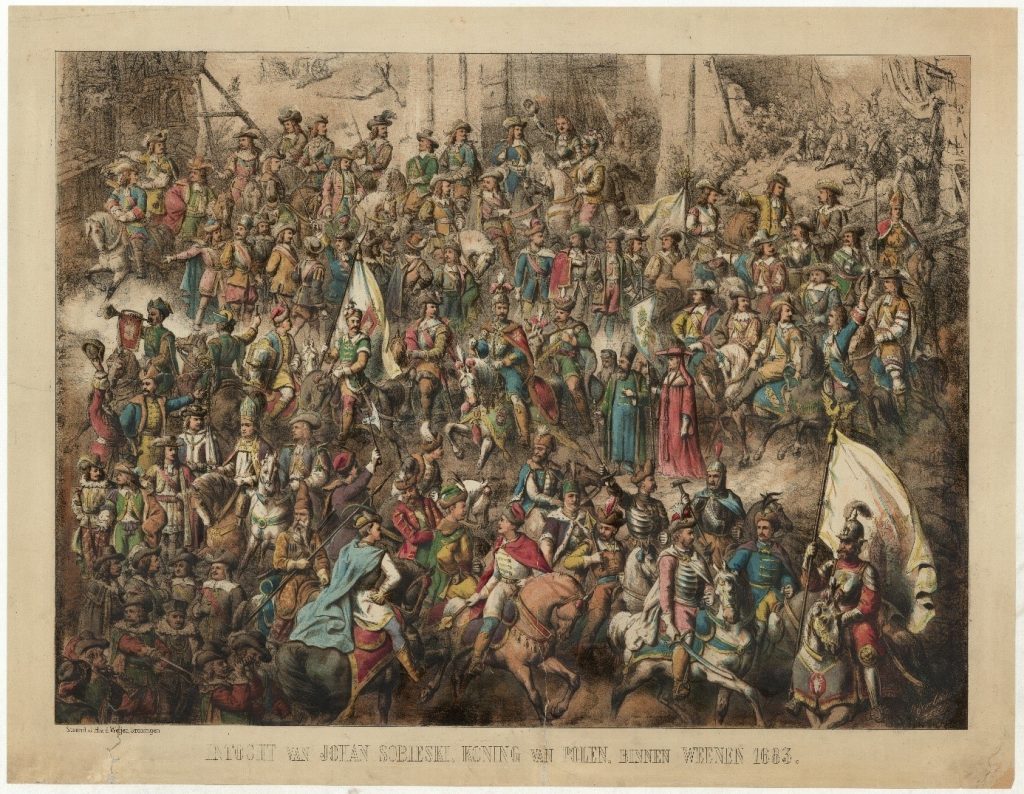 On this day in 1869, the city of Groningen witnessed a wondrous spectacle: the re-enactment of the entrance of King Jan III Sobieski of Poland into Vienna, in September 1683. At 7 pm, a masquerade of over seventy lavishly clad Dutch students began its passage through the city center, both on foot and on horseback. Such student masquerades were a common phenomenon in the nineteenth-century Netherlands, and they often portrayed specific historical events. An accompanying booklet enthusiastically relates Sobieski’s victory over the Turks at the Battle of Vienna, on 12 September 1683, and it also lists the masquerade’s participants, the roles they played, and the route they took through Groningen. Moreover, the booklet contains a small print based on a larger, colored illustration by the local artist Otto Eerelman. It depicts the masquerade as a long string of men in historical costumes of Polish and Austrian or German soldiers and clergymen, many wielding sabers, war hammers, lances, and flags. At the center of the print stands the masquerade’s main figure: Sobieski. Naturally, the print gives a fictional impression of the event, but one can imagine the excitement the masquerade must have caused in Groningen, which for one evening in 1869 played the role of Vienna welcoming Jan III Sobieski in 1683.
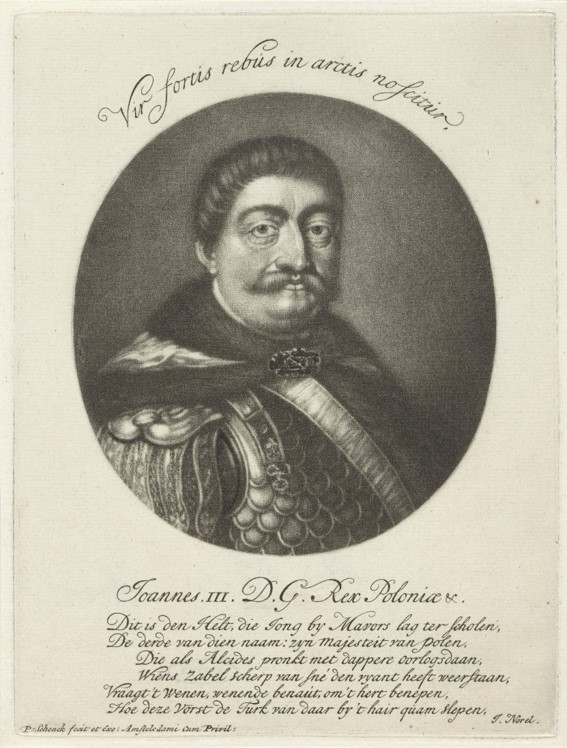 On 12 September 1683, King Jan III Sobieski of Poland achieved a decisive victory at the Battle of Vienna. In July that year, Turkish forces had laid siege to the imperial city as part of a campaign designed to strengthen the Ottoman Empire’s influence in Europe. Emperor Leopold I allied himself with Sobieski, who rode to Vienna’s aid and took command of the city’s relief. After the final battle took place, the Turks were routed and forced to retreat, eventually losing their foothold in Hungary and Transylvania.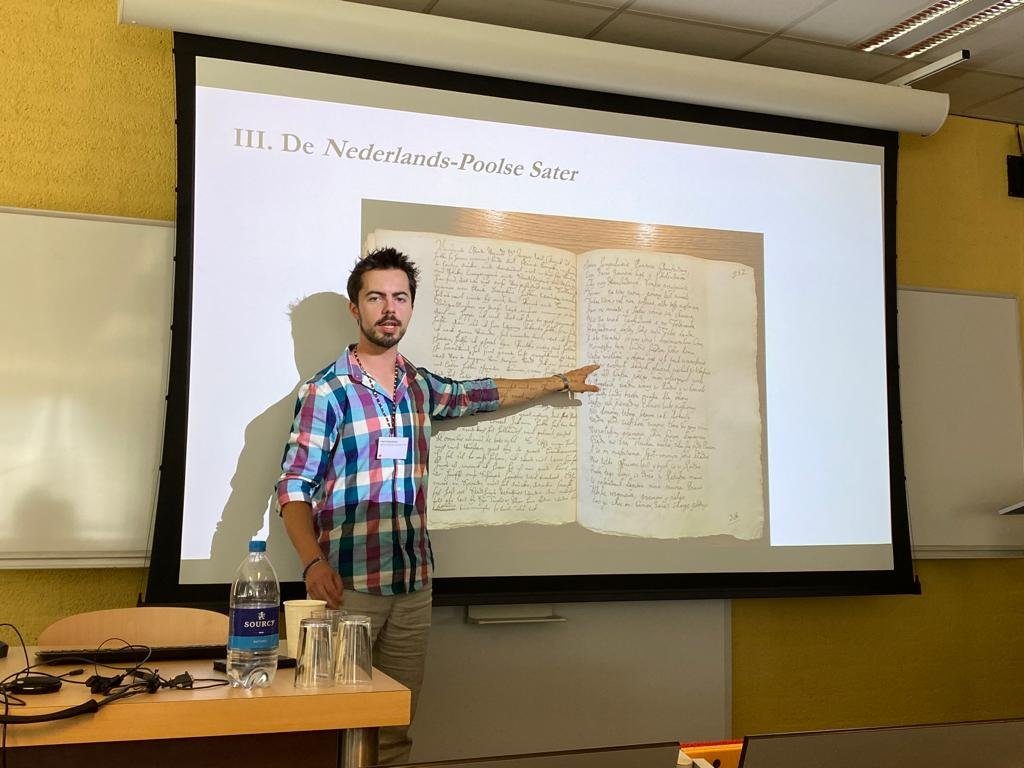
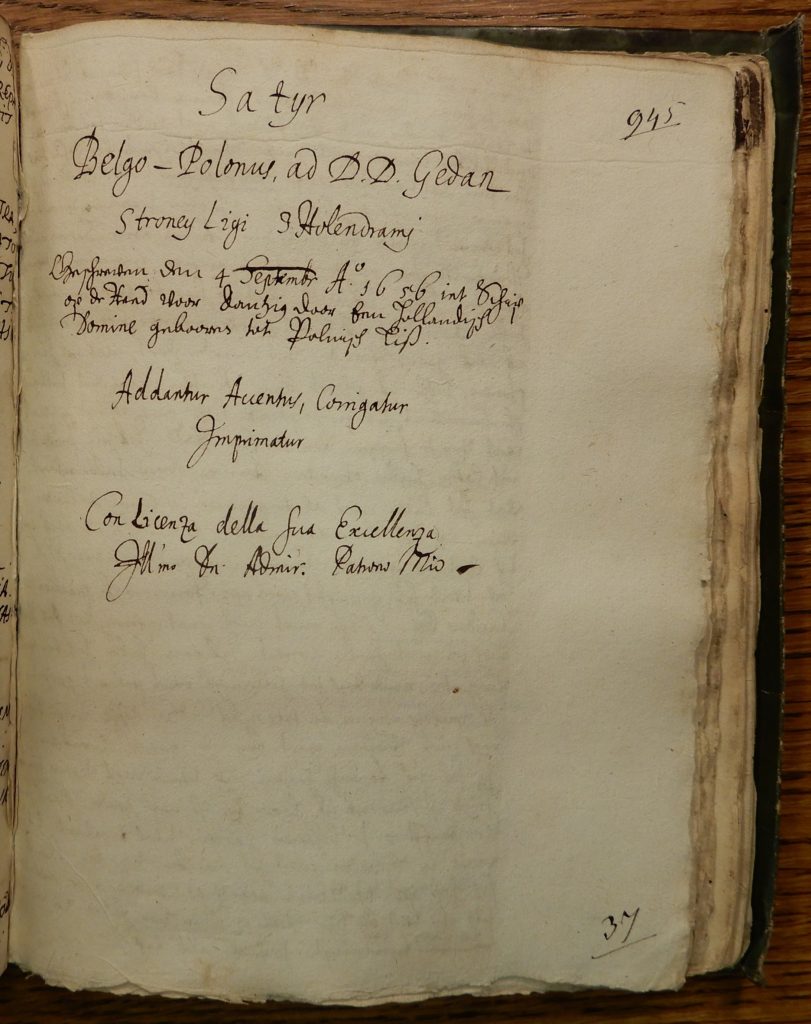 De titelpagina van het gedicht vermeldt dat de tekst in september 1656 op een schip voor Gdańsk is geschreven “door een Hollandisch Domine gebooren tot Polnisch Liss [Leszno]”. Die aanduiding wijst op Arnoldus. Het Poolse gedicht wordt voorafgegaan door een voorwoord in het Nederlands, waarin de auteur bescheiden stelt geen van beide talen goed te beheersen: “van alles kan ik een beetje, maar niks beheers ik volledig”. Bovendien maakt het voorwoord duidelijk dat Arnoldus betaald kreeg door een Nederlandse “admiraal” – vermoedelijk een van de scheepsvoogden die een paar maanden daarvoor met een vloot naar Gdańsk waren gevaren. Met andere woorden: Arnoldus handelde onder patronage van de Nederlanders.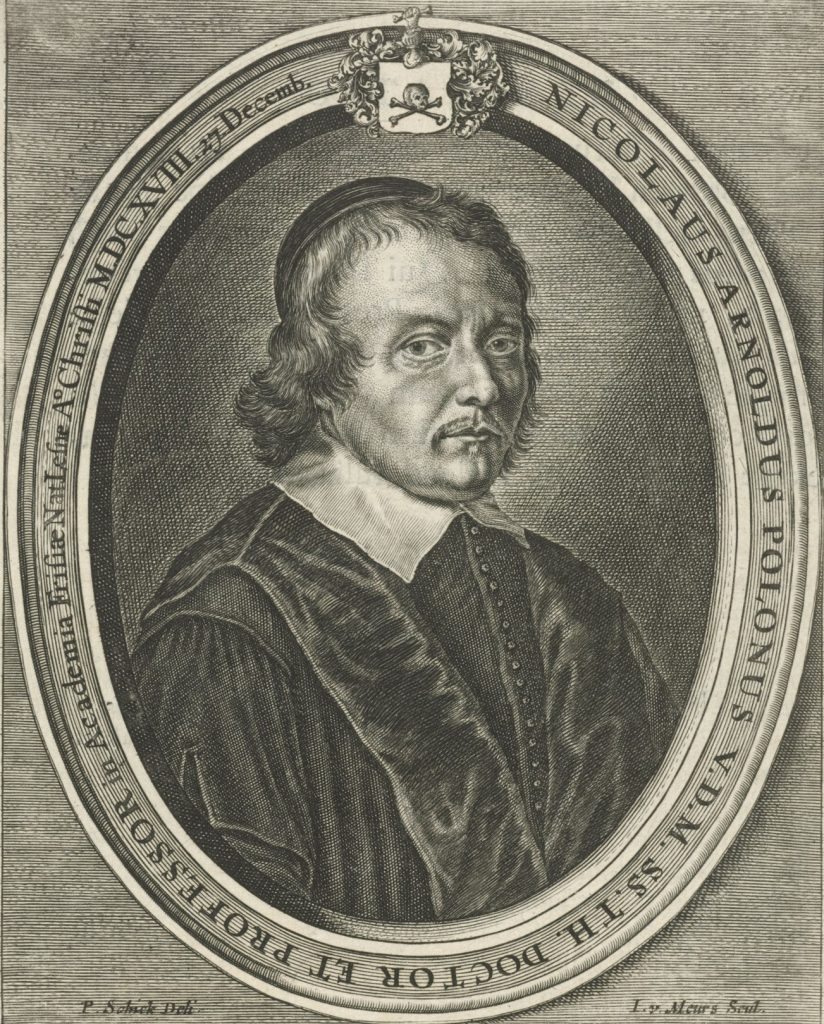
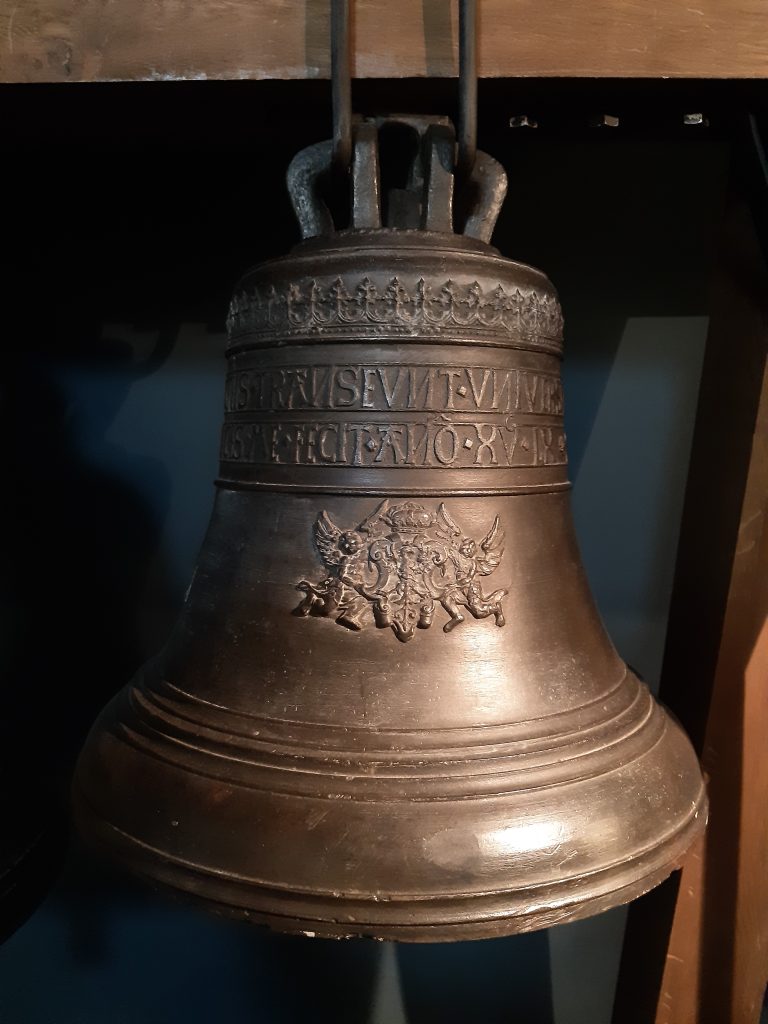 At this moment, the city of Gdańsk is busy hosting its annual Carillon Festival. An interesting example of the cultural relations between the Netherlands and Poland concerns the carillons in Gdańsk. In 1561, a carillon consisting of 14 bells was installed in the new tower of the Main Town Hall. The bells had been cast the previous year in ’s-Hertogenbosch, Brabant, by the bell-founder Johannes Moor. Together, they made up the oldest carillon outside the Low Countries. Each bell was adorned with the coat of arms of Gdańsk, Prussia and Poland, and carried a Latin sentence: “Time covers the whole world and everything under heaven passes in its spaces. Johannes Moor from ’s-Hertogenbosch made me in the year 1560.” Every hour, the carillon played two alternating melodies, which were changed weekly according to the liturgical calendar. Furthermore, a second carillon from the Northern Netherlands was installed in St. Catherine’s Church during the eighteenth century. It was cast by Johann Nicolaus Derck in Hoorn, Holland.